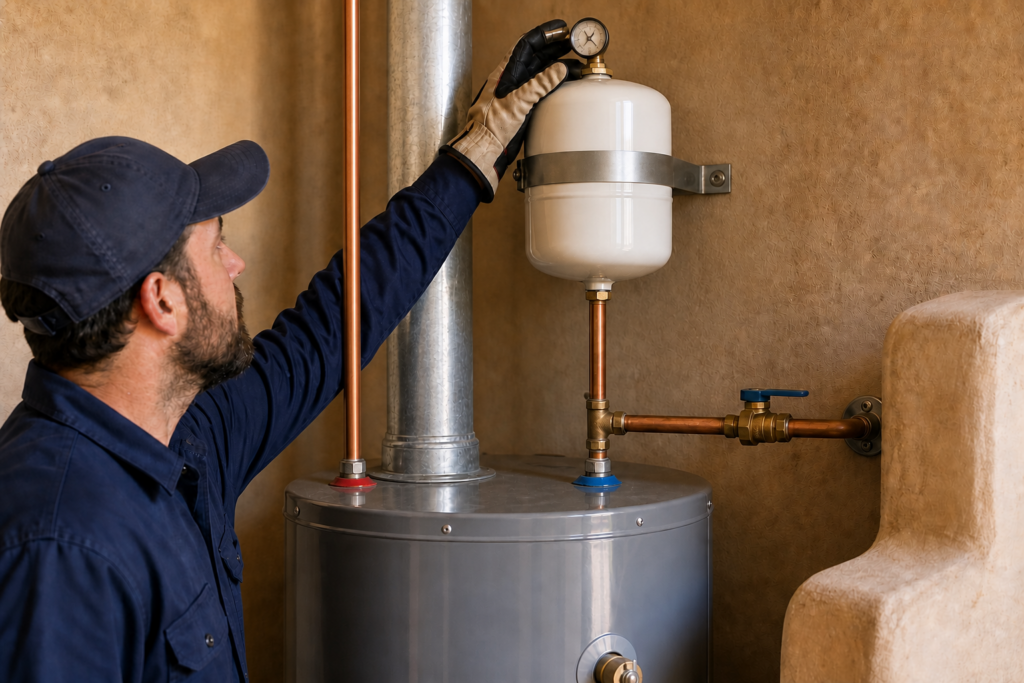
A conventional tank-style water heater may need a potable-water thermal expansion tank when heated water is trapped in a closed domestic plumbing system and cannot expand back toward the supply. Whether your Santa Fe home needs one depends on the water-supply arrangement, pressure controls, measured pressure behavior, water-heater manufacturer instructions, and the current requirements that apply to the property.
A Santa Fe address alone does not settle the question. Two neighboring homes can have different meters, backflow devices, pressure-reducing assemblies, well components, or prior plumbing changes. A licensed installer should verify the actual system before adding, replacing, or omitting an expansion tank.
Cypress B. PHC provides conventional water-heater installation and replacement in Santa Fe and can evaluate the heater and domestic-water supply together.
Why Stored Water Creates Thermal Expansion
Water increases slightly in volume as it heats. In a conventional storage water heater, a tankful of cold water is heated and held for later use. That additional volume needs somewhere to go.
In some plumbing systems, the expanded water can move back toward the incoming supply. In a closed system, a component or system arrangement prevents that reverse movement. Because water does not compress enough to absorb the change, pressure can rise while the burner or heating elements warm the stored water.
That pressure change is different from having excessively high incoming pressure all the time. It can also be different from a brief pressure change caused by a fast-closing fixture, appliance valve, pump, or other plumbing event. Measuring when and how pressure changes helps separate thermal expansion from another condition.
What Can Make a Domestic-Water System Behave as Closed?
A home may have equipment intended to protect the public supply, manage pressure, or control flow direction. Depending on its design and condition, that equipment can affect whether expanded water can move upstream.
Possible parts of the supply arrangement include:
- A backflow-prevention device.
- A check valve or another one-way control.
- A pressure-reducing assembly with a check feature.
- A meter or utility-side arrangement that prevents reverse flow.
- Pump, storage, or well-system controls with their own check-valve configuration.
Seeing one valve near the meter does not prove that the system is closed. Labels may be missing, components may have been replaced, and a device’s internal design may not be obvious from its exterior. The reliable approach is to trace the supply arrangement and evaluate pressure behavior with appropriate instruments.
Recent plumbing work can also change the answer. A new backflow device, meter, pressure-control assembly, or supply-line configuration may alter how the system handles expanded water even when the water heater itself has not changed.
What a Potable-Water Expansion Tank Does
Many potable-water thermal expansion tanks contain a flexible diaphragm or bladder that separates water from a sealed air cushion. As pressure rises during a heating cycle, a small amount of expanded water can enter the tank and compress the air side. As conditions return toward normal, the stored volume can move back into the domestic system.
The tank must be designed for potable water and selected for the actual water-heater and plumbing conditions. Its size, air charge, connection, orientation, support, and placement must follow the applicable instructions and requirements. A tank that is incompatible, improperly selected, unsupported, damaged, or incorrectly charged may not control expansion as intended.
An expansion tank is not a general pressure cure. It does not regulate excessive incoming pressure, add hot-water capacity, repair a leaking water heater, remove sediment, correct discolored water, or replace a temperature-and-pressure relief valve. Each of those conditions needs its own diagnosis.
When an Expansion-Tank Evaluation Makes Sense
A professional evaluation is especially useful during a conventional water-heater installation or replacement. The installer can confirm whether the domestic system is closed, review the new heater’s specifications, and determine how current requirements apply before the job is completed.
An evaluation is also appropriate when:
- A backflow device, check valve, water meter, pressure-reducing assembly, well component, or supply arrangement has recently changed.
- An existing expansion tank shows corrosion, leakage, movement, damaged support, or another visible concern.
- The replacement heater has a different storage capacity or operating specification from the previous unit.
- Pressure rises repeatedly during water-heating cycles.
- The temperature-and-pressure relief valve releases water, especially when the discharge follows a heating cycle.
- Supply connectors, valves, fixture seals, or appliance connections develop repeated pressure-related problems.
These observations do not prove that an expansion tank is missing or failed. A relief valve can discharge because of a valve problem, excessive temperature, high supply pressure, thermal expansion, or another unsafe condition. Repeated leaks can have installation, material, corrosion, movement, or pressure causes. The timing and measured conditions matter.
Pressure Symptoms Need Careful Interpretation
Thermal expansion often occurs during a heating cycle when no fixture is using water. A plumber may compare cold static pressure with pressure during and after heating, then review whether the pattern changes when water is drawn. That information is more useful than judging the system from one quick reading.
Homeowners can safely note when a symptom appears. Record whether water is released only after the heater runs, whether a recent plumbing change came first, and whether the issue affects one connection or several fixtures. If a pressure gauge is already part of the system, note what it shows without changing valves or attaching equipment.
Do not press the expansion tank’s air valve, add air, strike or tap the tank, adjust a pressure regulator, alter a backflow device, or install a test gauge as a trial repair. Those actions can release water or air, change the system’s settings, damage a component, or hide the condition a plumber needs to measure.
Keep Clear of Hot Relief Discharge and Active Leaks
The temperature-and-pressure relief valve is a safety device. Never cap, plug, block, or reduce its discharge path. An expansion tank is not a substitute for that valve, and replacing the relief valve without finding the cause may leave the pressure or temperature problem unresolved.
Keep away from active relief discharge because the water may be hot enough to cause injury. Stop using the heater and request prompt service if you see continuous discharge, steam, a bulging tank, a rapidly spreading leak, water near electrical parts, a burning odor, or unusual sounds accompanied by leakage.
If you smell gas near a gas-fired water heater, leave the area without operating switches or trying to inspect the appliance. Follow the gas utility’s emergency instructions from a safe location. Do not return until the area has been cleared by the appropriate professional.
What a Water-Heater Installer Should Verify
A reliable expansion-tank decision starts with the whole domestic-water system rather than the tank alone. The installer may:
- Confirm that the appliance is a conventional domestic storage water heater and review its manufacturer instructions.
- Trace the cold-water supply through the meter, pressure controls, check valves, backflow devices, pump equipment, and other relevant components.
- Measure incoming pressure and observe how pressure changes through a normal heating cycle.
- Inspect the temperature-and-pressure relief valve, discharge piping, water-heater connections, and any existing expansion tank for condition and compatibility.
- Determine whether the property needs a method of controlling thermal expansion under the current manufacturer instructions and requirements that apply to the work.
- Select and install any potable-water expansion tank from the actual heater capacity, supply pressure, operating conditions, and tank manufacturer’s data.
- Verify placement, connection, support, and post-installation pressure behavior before returning the system to normal use.
This assessment may involve more than the water heater. Cypress B. PHC can review related residential plumbing conditions when the supply arrangement or pressure controls affect the decision.
Santa Fe Requirements Must Be Checked for the Exact Property
There is no responsible one-sentence answer claiming that every water heater in Santa Fe needs the same expansion tank. The adopted requirements, property jurisdiction, equipment, supply configuration, and scope of work all matter. Manufacturer instructions may also impose conditions that apply to a particular heater or tank.
Ask the installer which current requirements apply, what makes the domestic system open or closed, which measurements support the recommendation, and how the proposed tank was selected. A clear answer should connect the component to the actual plumbing conditions rather than to a blanket sales rule.
A Boiler Expansion Tank Is a Different Component
Cypress B. PHC also works with boilers and radiant heating, but a boiler or hydronic expansion tank belongs to a closed heating loop. It manages expansion in the fluid that circulates through the boiler, radiators, baseboards, or radiant-floor tubing. It is selected for that heating system’s volume, temperature, pressure, and equipment.
A potable-water thermal expansion tank serves the domestic water connected to a conventional storage water heater. The two tanks can look similar, but they are not interchangeable. If the concern involves a heating loop rather than household hot-water plumbing, it needs a separate boiler and hydronic-system assessment.
Frequently Asked Questions
Does every conventional tank water heater need an expansion tank?
No. The decision depends on whether the domestic system is closed, how pressure behaves, the heater and tank manufacturer instructions, and the current requirements that apply to the installation. The supply arrangement must be verified rather than assumed.
Does a dripping relief valve prove that the expansion tank failed?
No. Thermal expansion is one possible cause, but excessive supply pressure, excessive temperature, a relief-valve problem, or another condition may also cause discharge. Keep clear of hot water and have the heater inspected.
Can an expansion tank lower high incoming water pressure?
It is not a pressure regulator. If incoming pressure is excessive before the heater runs, the pressure-control and supply conditions need separate evaluation. An expansion tank is intended to accommodate a limited change in water volume under the conditions for which it was selected.
Can an old expansion tank be reused with a replacement heater?
That should not be assumed. The installer needs to assess the tank’s potable-water rating, condition, compatibility, size, charge, connection, and support against the replacement heater and current system.
Can a homeowner size or install the tank?
Sizing and installation depend on measured pressure, heater capacity, temperature conditions, manufacturer data, piping arrangement, support, and applicable requirements. Incorrect work can create leaks, pressure problems, or an unreliable safety arrangement, so this is a job for a qualified installer.
Schedule a Water-Heater Expansion Assessment in Santa Fe
A thermal expansion tank is appropriate when the actual domestic-water system, heater specifications, pressure behavior, and applicable requirements support it. It should not be added from a guess, and it should not be omitted because the old installation lacked one.
To have a conventional tank water heater and its supply arrangement evaluated, contact Cypress B. PHC. Share whether the heater is being replaced, whether pressure-control or backflow equipment recently changed, and when any discharge or pressure symptom occurs.