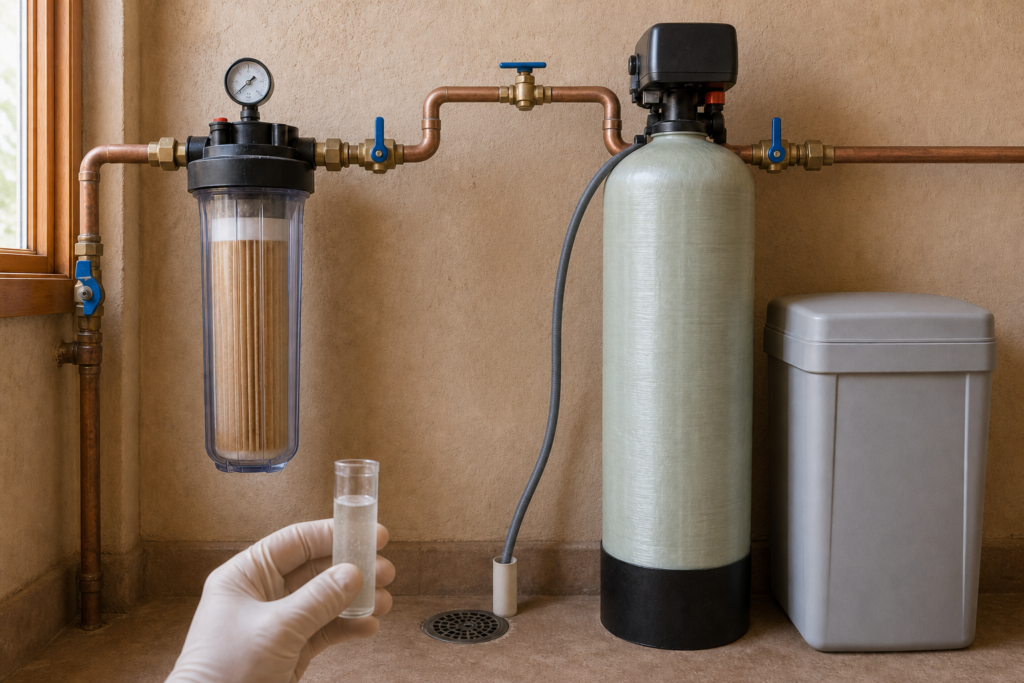
A whole-house water filter and a water softener solve different water conditions. A filter uses a cartridge or treatment media to reduce specific particles, tastes, odors, or other substances it is designed for. A traditional ion-exchange softener reduces dissolved hardness minerals. One system should not be expected to perform the other system’s job unless its specifications and test data show that capability.
White spotting, cloudy water, sediment, or an unusual taste can help describe a concern, but appearance alone cannot identify what is in the water. The practical first step is a current water test, followed by an assessment of the home’s water source, plumbing, peak flow, pressure, available space, drain access, and maintenance needs.
Cypress B. PHC provides whole-house water-filtration service in Santa Fe and can compare measured water conditions with the equipment and plumbing requirements before a system is selected.
A Filter and a Softener Do Different Jobs
The word “filter” covers many products. A basic sediment cartridge may trap suspended grit or rust particles. Activated-carbon media may reduce certain tastes, odors, or chemicals under the operating conditions listed for that product. Other media are designed for particular substances. The media, rating, flow, contact time, and replacement schedule determine what a filter can reasonably address.
A conventional water softener operates differently. Its resin exchanges hardness minerals, primarily calcium and magnesium, for another ion as water passes through the tank. The resin is periodically regenerated so it can continue treating hardness. A softener is therefore selected from measured hardness, household demand, service flow, and regeneration requirements rather than from the color or size of the tank.
Neither label is a complete treatment plan. A sediment filter is not automatically a softener, and a softener is not a general-purpose contaminant filter. Some packaged systems combine more than one treatment process, but each stage still needs a defined job and verified operating range.
What Whole-House Filtration May Address
A whole-house filter is installed on the main water supply so the selected treatment applies before water reaches most fixtures and appliances. The result depends entirely on the system’s design.
Mechanical filtration may be useful when a test or inspection confirms suspended particles. A cartridge with an appropriate micron rating can capture particles larger than its rated threshold, but a finer cartridge can also restrict flow more quickly if the water carries a heavy sediment load. The housing, cartridge area, and expected replacement interval must be sized for the actual condition.
Carbon and other adsorptive media may be selected for particular taste or odor concerns. Capacity depends on the substance being treated, its concentration, water chemistry, flow rate, and contact time. A product should be evaluated against the measured condition and its published performance data, not a broad “whole-house filter” label.
Specialized treatment may be needed when testing identifies iron, manganese, arsenic, nitrate, microorganisms, or another specific concern. Those conditions should not be guessed from color, staining, taste, or smell, and no single filter technology should be assumed to address all of them.
What Ion-Exchange Softening Addresses
Hard water contains dissolved calcium and magnesium. As water evaporates or is heated, those minerals can contribute to scale on fixtures, inside water-heating equipment, and in other surfaces that regularly contact water.
An ion-exchange softener reduces hardness before the treated water moves through the home. It can help control hardness-related scale and change how soap behaves. It does not remove every dissolved substance, make an unsafe water supply safe, or guarantee that a taste or odor will disappear.
Softener selection is more than choosing a tank size. A professional needs the measured hardness, expected water use, peak service flow, resin capacity, regeneration method, available water pressure, drain location, and maintenance expectations. If the water contains sediment or another condition that can foul the resin or control valve, pretreatment may also be needed.
Regeneration uses water and a regenerant stored in the brine tank. The exact frequency and amount depend on the unit, settings, measured hardness, capacity, and household demand. A fixed schedule copied from another home can waste resources or allow hardness breakthrough.
Symptoms Can Point in More Than One Direction
Homeowners often start comparing equipment after seeing a visible or sensory change. Those observations are useful to record, but several conditions can look similar.
White spots or crust on fixtures
Hardness minerals can leave white scale after water evaporates, especially on frequently wet surfaces. A laboratory or reliable field hardness test can confirm the level. White residue can also come from other dissolved solids, cleaning products, or a local fixture condition, so the residue alone does not select a softener.
Grit, rust-colored particles, or cloudy water
Particles may come from the source water, a water heater, aging piping, a disturbed main, corrosion, or another part of the plumbing system. Cloudiness may be suspended material, tiny air bubbles, or a different water-quality condition. Comparing hot and cold water, one fixture and the whole home, and the timing of the change helps determine where testing should begin.
Chlorine-like, metallic, earthy, or sulfur-like odor
Odor can originate in the source water, a water heater, a drain near the fixture, plumbing materials, or biological activity. The exact source matters. Smelling an odor at one sink is not enough to choose carbon media, replace a water heater component, or disinfect a private system.
Soap does not lather as expected
Hardness can affect soap performance, but product formulation, water temperature, and the amount used also matter. A hardness test gives a better basis for treatment than soap behavior alone.
Test the Water Before Selecting Equipment
Testing should match the water source and the concern. A home supplied by a public system may have utility water-quality information that provides useful context, while a private well requires property-specific consideration. Plumbing after the service connection can also change what reaches a particular tap.
Begin with a sample collected and handled according to the test provider’s instructions. The test may need to measure hardness, pH, total dissolved solids, sediment, iron, manganese, disinfectant residual, or a concern specific to the source and symptoms. A broad screening result does not replace a targeted laboratory analysis when health or safety is involved.
Recent plumbing work, a vacant period, changes at the water source, seasonal conditions, or a water-heater issue can affect timing. Record when the concern began, whether it appears in hot water, cold water, or both, and whether every fixture is affected. That information helps the plumber choose a representative sampling point and inspect for a local plumbing cause.
Treatment should be matched to the result. If the test shows hardness without a separate filtration concern, softening may be the relevant process. If it shows sediment or a substance addressed by certified filtration media, a filter may be appropriate. If it shows both, a properly ordered treatment train may be considered.
Some Homes Need More Than One Treatment Stage
A combined system does not mean placing any filter next to any softener. The order and sizing of each stage depend on the measured water conditions and on how one stage affects the next.
A sediment stage may protect downstream valves or media when suspended material is present. A carbon stage may be chosen for a defined taste, odor, or chemical target. A softener may follow or precede another treatment stage according to the equipment manufacturer’s requirements and the water chemistry. Ultraviolet, reverse-osmosis, oxidation, neutralization, or other treatment may be relevant only when testing establishes the condition and the system is designed for it.
Every stage adds pressure loss, maintenance, and another point that must be accessible for service. Unnecessary equipment can reduce flow, complicate maintenance, and create expense without solving a measured problem. The smallest effective treatment train is usually easier to operate than a collection of devices selected from symptoms alone.
Plumbing Conditions Affect System Performance
The water test identifies what needs treatment. The plumbing assessment determines whether the selected equipment can serve the home without creating a new problem.
Service flow and pressure
The equipment must handle the home’s realistic peak flow. A small filter housing or restrictive cartridge may cause weak flow when several fixtures operate. A softener control valve and resin bed also have service-flow limits. Inlet pressure, pressure loss through each stage, and the required pressure at fixtures should be checked together.
Main-line size and connection layout
Reducing the main water line through undersized fittings can restrict flow. The installer should confirm pipe material, diameter, connection method, shutoff condition, grounding or bonding considerations where applicable, and a layout that permits service without placing stress on the plumbing.
Bypass valves and isolation
A proper bypass allows treatment equipment to be isolated for maintenance while preserving a controlled water path when the installation supports it. The valves should be accessible and clearly arranged. Homeowners should not operate an unfamiliar bypass during a leak, pressure problem, or water-quality event without knowing where the water will flow.
Drain and power requirements
Many softeners and backwashing filters need a correctly sized, code-appropriate drain connection and an air gap. Some control valves also need power. Drain routing, discharge volume, freeze protection, electrical access, and the effect on a septic system or other disposal arrangement must be evaluated for the property.
Space and maintenance access
Cartridges need room for housing removal. Media tanks require access to controls and connections. Brine tanks need a practical path for approved regenerant and cleaning. Equipment should not block electrical panels, combustion-air openings, water-heater access, or other utilities.
Cypress B. PHC can evaluate these residential plumbing conditions as part of a water-treatment installation assessment.
Questions to Ask During a Water-Treatment Assessment
Clear answers make it easier to compare proposals and maintain the system later:
- What current test result is each treatment stage designed to address?
- Which substances or particle sizes is the exact media rated to reduce?
- What service flow and pressure loss should the home expect?
- How was softener capacity calculated from measured hardness and demand?
- What maintenance, cartridge replacement, backwashing, or regeneration is required?
- Where will the bypass, drain, power supply, and sampling points be located?
- How will treated and untreated exterior lines be arranged, if applicable?
- What result should be retested after installation, and at what interval?
- What visible change would indicate a clogged cartridge, exhausted media, hardness breakthrough, or another service need?
Keep the laboratory report, equipment model information, media specifications, and maintenance record together. Those records help a technician distinguish a treatment issue from a plumbing or source-water change.
Frequently Asked Questions
Will a whole-house filter soften hard water?
Not unless the exact system includes a process designed and verified to reduce hardness. Sediment and carbon filters generally perform different jobs from ion-exchange softening. Check the equipment’s published treatment method and performance data.
Will a water softener remove chlorine taste or sediment?
A traditional softener is designed to reduce hardness minerals. It should not be assumed to remove sediment, chlorine taste, odor, or a measured contaminant unless the exact system has an additional rated treatment stage.
Do white spots prove that the water is hard?
White scale is consistent with hardness, but it is not a complete water test. Other dissolved solids or residues can look similar. Measure hardness before sizing or programming a softener.
Can I install both systems to cover every possibility?
More equipment is not automatically better. Each stage should address a measured condition, be placed in the correct order, handle the required flow, and have a realistic maintenance plan. Unnecessary stages can add pressure loss and service work.
Where should the water be tested?
The sampling point depends on whether the concern affects the incoming supply, hot water, one fixture, or the whole home. Follow the test provider’s collection instructions and use a representative tap. A plumber can help isolate a water-heater or plumbing-source issue before treatment is selected.
Choose Treatment From Measurements, Not Guesswork
A filter is the right tool only when its media is designed for the measured condition. A softener is the right tool when confirmed hardness and household demand justify ion exchange. Some homes need both processes in a carefully ordered system, while others need a plumbing repair, water-heater service, or no additional equipment at all.
Bring your observations, recent test results, water-source information, and peak-flow needs to the assessment. Contact Cypress B. PHC to compare the water condition with the home’s plumbing and choose a maintainable treatment plan for your Santa Fe property.