The right tankless water heater must deliver enough hot water for the fixtures your household may use at the same time, at the temperature rise your home actually requires. Household size and the largest GPM number on a product label are not enough to choose a unit.
Tankless performance changes with incoming-water temperature, the desired outlet temperature, fuel or electrical capacity, and installation conditions. A model that delivers plenty of water under one set of conditions may provide less flow when it has to produce a greater temperature rise.
Cypress B. PHC provides tankless water-heater installation and repair in Santa Fe and can compare your household’s expected demand with manufacturer performance data before recommending equipment.
Start With the Fixtures That May Run Together
Begin by listing the hot-water fixtures that are realistically used at the same time. One person may shower while another runs a bathroom sink, starts the dishwasher, or uses hot water in the kitchen. The important number is the combined hot-water demand during that busy period, not the total number of fixtures in the house.
Use actual fixture flow when possible. A showerhead or appliance label may provide a rated flow, while a plumber can measure fixtures when the rating is unavailable. Because faucets and showers mix hot and cold water, their total flow and their hot-water demand may not be identical. The sizing assessment should account for how the fixtures are normally used rather than simply adding every fixture in the home.
It also helps to separate normal demand from rare demand. Sizing for every shower, sink, appliance, and tub to operate at once can lead to an unnecessarily large system. Ignoring common overlaps can leave a unit unable to maintain the expected temperature.
Temperature Rise Changes How Much Hot Water a Unit Can Deliver
Temperature rise is the difference between the incoming cold-water temperature and the desired hot-water temperature. The greater the rise, the more heating work the unit must perform for every gallon passing through it.
Incoming water is not identical in every home or every season. It should be measured or established from reliable property-specific information instead of assumed from a generic Santa Fe number. The desired outlet temperature must also be selected with household safety and the manufacturer’s instructions in mind.
For example, if the incoming water becomes colder while the outlet target stays the same, the required rise increases. The unit may then deliver fewer gallons per minute than it can under warmer incoming conditions. That is why a maximum advertised GPM rating cannot answer the sizing question by itself.
Read the Manufacturer’s Performance Curve
Tankless manufacturers publish performance information showing how much flow a model can deliver at different temperature rises. The useful rating is the delivered GPM at the home’s expected operating conditions.
Compare the household’s simultaneous hot-water demand with the model’s performance at the required rise. The selected unit should meet that demand without relying on a maximum-flow figure measured under easier conditions.
The performance curve also makes product comparisons more meaningful. Two units promoted with similar maximum flow may perform differently when they must create the same temperature rise. Fuel type, heat-exchanger design, input capacity, controls, and installation settings can all affect delivered performance.
A tankless system can heat water continuously, but it does not provide unlimited flow. If demand exceeds the unit’s capacity at that moment, the result may be a lower outlet temperature, reduced flow, or inconsistent comfort.
Confirm Gas or Electrical Capacity Before Choosing a Model
A gas-fired tankless unit needs an adequate fuel supply at the conditions specified by its manufacturer. The meter, regulator, piping route, pipe size, other gas appliances, and available pressure all affect whether the system can receive the required input.
A high-capacity unit does not create more fuel capacity. If the existing gas system cannot support the selected model, the installation may require a different equipment choice or properly designed utility work. Gas-line calculations and adjustments should be handled by qualified professionals.
Electric tankless models can place a substantial demand on a home’s electrical system. Voltage, breaker and conductor requirements, panel capacity, and the total available service must be evaluated for the exact model. A unit should not be selected until the electrical supply is confirmed, and homeowners should not attempt wiring or panel changes themselves.
The best equipment choice is one the home can support safely and reliably. A larger advertised capacity has little value if the necessary fuel or electrical infrastructure is not available.
Venting, Combustion, and High-Altitude Requirements Matter
Gas models have specific venting, combustion-air, clearance, termination, and condensate requirements. These requirements vary by model, so an existing vent should not be assumed compatible with a replacement unit.
Santa Fe’s high-elevation conditions make the manufacturer’s altitude instructions especially important. Some models require approved settings, components, or capacity adjustments within specified elevation ranges. The correct approach is to follow the exact model documentation rather than apply one general derating percentage to every unit.
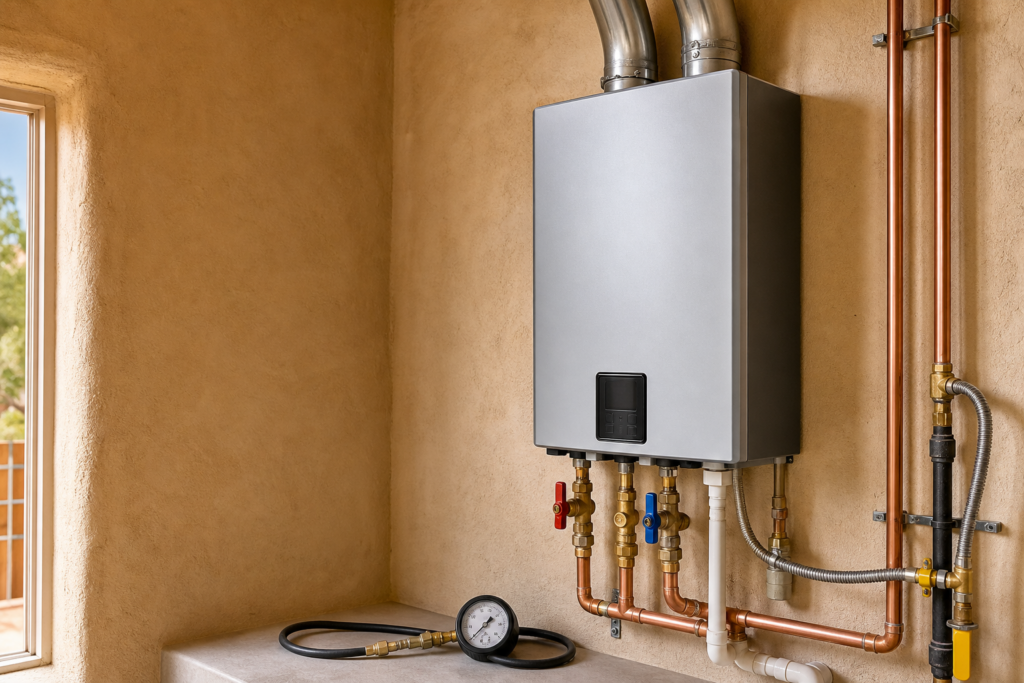
Placement also affects the installation. The plumber needs to consider access for maintenance, the route for water and fuel connections, vent termination, condensate disposal when applicable, and protection of vulnerable piping. These conditions can influence which model and installation approach fit the home.
A Bigger Tankless Water Heater Is Not Always the Fix
Low flow or temperature changes do not automatically prove that the unit is undersized. A clogged inlet filter, mineral scale in the heat exchanger, restricted piping, a fixture problem, inadequate fuel pressure, electrical limitations, or overdue maintenance can produce similar symptoms.
Before replacing an existing unit with a larger one, a plumber should confirm the actual demand and inspect the system. If the current model was properly sized but cannot reach its rated performance, correcting the underlying restriction or service problem may be the appropriate solution.
Oversizing can also add unnecessary equipment and infrastructure cost without improving normal comfort. The goal is not to buy the largest unit available. It is to select a system that meets realistic peak demand at the required temperature rise and works with the home’s utilities and installation conditions.
Information to Gather Before a Sizing Assessment
A few details can make the first conversation more productive:
- The number and type of showers, tubs, sinks, and hot-water appliances
- Which hot-water fixtures commonly operate at the same time
- Available fixture flow ratings or measurements
- The current water-heater model and fuel type
- Any temperature changes, flow problems, or error codes
- Other appliances sharing the gas supply
- Available electrical-panel information for an electric option
- The preferred installation location and any existing vent route
These details are a starting point, not a substitute for an on-site assessment. Final selection should use measured conditions and the performance information for the exact model being considered.
Choose the Right Tankless System for Your Santa Fe Home
A properly selected tankless water heater should meet your realistic simultaneous demand at the required temperature rise while staying within the home’s fuel or electrical capacity. It must also satisfy the chosen model’s venting, placement, and high-altitude requirements.
Cypress B. PHC can assess fixture demand, installation conditions, utility capacity, and manufacturer performance data before recommending a system. To discuss a tankless water-heater installation for your home, contact Cypress B. PHC.